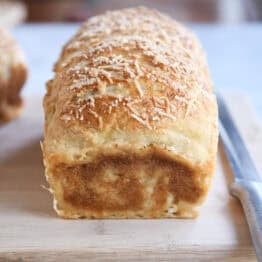
Amazing Bagel Bread
Ingredients
Bread:
- 2 ½ cups warm water
- 4 tablespoons honey
- 1 ½ tablespoons instant or rapid-rise yeast (see note for active dry yeast)
- 1 ½ tablespoons coarse kosher salt (use half for table salt)
- 5 to 5 ½ cups (709 to 780 g) bread flour (see note for substitutions and notes about exact flour amount)
Topping:
- 1 egg, lightly beaten
- ½ cup (57 g) freshly grated Parmesan or Asiago cheese, or other toppings of choice, like sesame seeds, poppy seeds, Trader Joe's everything but the bagel seasoning, etc
Water Bath:
- 4 quarts water
- ¼ cup (85 g) honey
- 1 tablespoon baking soda
Instructions
- For the bread, in the bowl of a stand mixer fitted with the dough hook, combine the water, honey, yeast, salt and 2 cups of the flour. Mix until combined.
- With the mixer on low speed, continue adding flour until the dough comes together and clears the sides of the bowl. The exact amount of flour doesn't matter as much as the texture and feel of the dough. It should form a soft ball that doesn't leave a lot of dough residue on your fingers - this dough does better if it is properly floured. It shouldn't be overly sticky.
- Knead the dough for 5 minutes.
- Cover the mixing bowl and let the dough rest for 10-15 minutes (or up to an hour).
- Turn the dough out onto a lightly greased or floured counter and separate into two pieces.
- Shape each piece into a loaf by pressing into a thick rectangle, folding the bottom edge up to the middle and then grabbing the top edge and folding it down over the dough and pinching the seam to seal.
- Turn the loaf seam side down and pat and roll lightly to form an even 8-inch loaf. It's important for the bread to be in a very sturdy, well-formed, and well-sealed loaf shape so it doesn't unravel in the water bath.
- Grease two 8 1/2-X-4 1/2-inch loaf pans. Place the loaves seam side down in the prepared pans.
- Cover with a clean kitchen towel or greased plastic wrap and let rise in a warm, draft-free spot until the dough rises just over the edge of the pan, about 45 minutes to an hour.
- For the water bath, toward the end of rising, prepare the water bath by bringing the water, honey and baking soda to a boil in a pot (that is at least 10 inches wide).
- Fold a clean non-textured kitchen towel (I use a flour sack towel) in half and place next to the stove.
- Preheat the oven to 350 degrees F.
- One at a time, carefully turn each loaf of risen dough out into your hand and place the loaf into the boiling water. It's ok if the bread loaf deflates and looks a bit wonky. It will all work out! Trust the process.
- Cook for 1 minute. Use a wide flat spatula or other tool/spoon to flip the dough and cook for another 45 seconds to 1 minute.
- Using two wide spatulas, carefully transfer the loaf onto the folded towel, using extra towel length to pat any water off the top and sides of the dough. I usually roll the loaf completely up in the towel and pat it on all sides to dry it as thoroughly as possible.
- Spray the same loaf pan with cooking spray and sprinkle a couple tablespoons of cheese evenly across the bottom of the pan.
- Unroll the dough from the towel and transfer to the pan (use the towel to help transfer the hot loaf, if needed). Tuck the dough down into the edges of the pan in a mostly even shape. It will likely look fairly bumpy and rustic - that's normal.
- With a baker's lame or sharp serrated knife, cut five or six slashes about 1/4-inch deep crosswise on the top of each loaf of dough.
- Brush the top of with the beaten egg and sprinkle each loaf with a couple more tablespoons of cheese.
- Bake the bread in the preheated oven for 40 to 45 minutes until golden on top (an instant-read thermometer should read 200 degrees at the center of the loaf). This bread needs to bake longer than a typical loaf of bread so it isn't soggy on the bottom.
- Let the bread cool for a few minutes in the pan before turning onto a cooling rack to cool completely.
- Slice, toast, slather with cream cheese, devour!
Notes
Yeast: if using active dry yeast instead of instant yeast, use the same amount of yeast but proof it in 1/4 cup water and a pinch of sugar or drop of honey until bubbly and foaming before adding to the other ingredients in the mixer. If doing so, decrease the water in the recipe by 1/4 cup.
Flour: Bread flour is important in this recipe for a sturdier loaf. However, if you don't have bread flour, I've had good luck subbing in all-purpose flour + vital wheat gluten (I use 1/2 cup vital wheat gluten). Take care not to under flour the dough. It helps if this dough is slightly sturdier than a typical soft, bread dough.