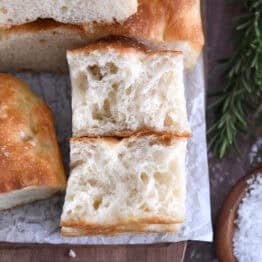
Easy Ultra-Fluffy Focaccia Bread
Ingredients
- 3 ½ cups (497 g) bread flour (see note)
- 2 ½ teaspoons instant yeast (see note)
- 2 teaspoons table salt
- 1 ¾ cups plus 2 tablespoons (427 g) very warm water, 105 to 110 degrees F (see note)
- 6 tablespoons olive oil, divided
- Flaky sea salt, for sprinkling on top of dough
Instructions
- In a large bowl, add the flour, yeast and salt. Mix to combine.
- Add the water and 2 tablespoons olive oil (24 g). Mix until the dough is shaggy and no dry streaks remain, scraping down the sides of the bowl well. Cover the bowl and let the dough rest for 30 minutes.
- Rub hands lightly with olive oil or run under cool water (so the dough doesn't stick). Grab one edge of the dough and lift and stretch it up and over to the other side. Turn the bowl slightly, and grab another edge, lifting and stretching up and over to the other side. Continue this process, moving around the edge of the dough, until you have stretched and folded the dough 12 to 15 times. This process helps develop structure and form the bubbly interior of the bread.
- Re-oil hands if needed and gently turn the bread over so the seams from stretching and folding are on the bottom. It's ok if it doesn't look perfect, just cup your hands and tuck the dough in towards the bottom forming as round of a shape as possible.
- Cover the bowl and let the dough rest for 20 to 30 minutes. This helps relax the gluten in the dough - you can skip this step, if needed.
- Take a sheet of parchment paper about 12X16-inches and crumple into a ball. Unfold and smooth out the parchment and then press it into the corners and up the sides of a light-colored metal or glass 9X13-inch baking pan.
- Drizzle 2 tablespoons of olive oil over the bottom of the parchment paper.
- With oiled hands, gently lift the dough out of the bowl and place in the center of the prepared pan, gently and very lightly stretching it into a thick oval shape (it won't cover the entire bottom of the pan at this point).
- Cover the pan and let the dough rise until it has filled most of the pan and is super puffy, 1 to 1 1/2 hours.
- Preheat the oven to 475 degrees F for a light-colored metal pan and 450 degrees F for a glass pan. Place an oven rack in the center position.
- When the oven has fully preheated, drizzle the top of the dough with 1 to 2 tablespoons olive oil.
- Use your fingers and slowly press into the top of the dough all the way to the bottom of the pan. Lift your fingers up and out of the dough gently (if the dough is sticking to your fingers, drizzle a bit more olive oil across the dough). Dimpling the dough slowly and gently gives the focaccia the signature dimples without deflating the dough. Repeat this process all across the dough.
- Sprinkle the top of the dough with flaky sea salt.
- Bake for 16 to 17 minutes (for a metal pan at 475 degrees F) and 18 to 20 minutes (for a glass pan at 450 degrees F) until the bread is golden and baked through.
- Lift the bread out of the pan using the parchment corners and place on a wire rack to cool completely.
- Cut into squares and serve. This bread is fantastic as a side dish and it also makes excellent sandwiches (slicing the bread in half lengthwise).
Notes
Bread Flour: This focaccia bread turns out fluffier with bread flour. In a pinch, you can sub in all-purpose flour, but bread flour produces a superior end result.
Yeast: I keep my yeast in a quart-size jar in the freezer and measure out, as needed, for recipes. If you are using packets of yeast, one packet (about 2 1/4 teaspoons) will work fine for this recipe.
Water: If possible, I recommend weighing the water (and flour, too). The water should be very warm - but not too hot or it will kill the yeast.
Flaky Sea Salt: This adds tremendous flavor and a little crunch to the top of the bread. I prefer using flaky sea salt (like Maldon). If you don't have sea salt flakes, coarse salt can be used instead.