

How to Get Dinner on the Table Without Losing Your Sanity {Full Presentation}
Over the years, I have been asked many, many times to speak to groups of women, college students, widows/widowers, and countless others about:
- planning a menu
- making dinner
- surviving dinner time
- cooking for picky eaters
- budgeting
- and pretty much any and all topics related to this
Inevitably, almost every one of these presentations ends up being titled:
➡️ How to Get Dinner on the Table Without Losing Your Sanity ⬅️
(Can I get an amen?? So many of us can relate to this topic!)
Since I’m unable to give this same presentation to all of you in person (I wish I could!), and after a great demand for the material, I decided to put the entire presentation in a blog post for you to reference when needed OR for you to present this to others in your community if the need arises.
Below are all the details of the presentation I give (including my dumb jokes) AND links to all the handouts (free!) that I give during the presentation.
Even if you don’t ever use this material to actually present to anyone else, hopefully it will be helpful to you as you slog through day after day of getting dinner on the table for you and yours. 😘
Ahem. Let’s begin.

And I’ve been talking about food online for almost 20 years.
I started my food blog decades ago to combat loneliness and a bit of boredom from what I like to call “The Toddler Years” while we were living in Wisconsin and I had three kids under the age of three which soon became four kids under the age of four, and yes I know how babies are made, and yes, I still chose that, and yes there were days I wanted to run far far away.
Way back in the day, my food pictures were really, really bad. ⬇️

Over the years, they’ve improved a bit. ⬇️

And along with better pictures, I’ve somehow also gained millions of readers, and it’s really the best job ever.
I’ve been publishing recipes on the internet for a long time, which means I’ve seen the full gamut of human decency.
The large majority of the comments I receive are something like this:

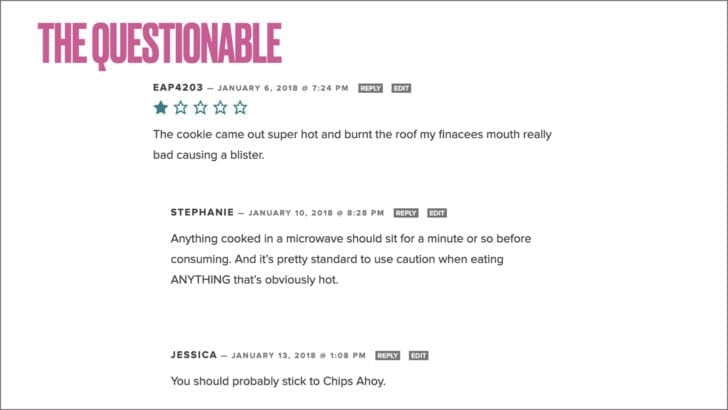
I also get some rather questionable comments like this entertaining thread:
And of course, because we live in a very strange, weird world, I also get comments like this:
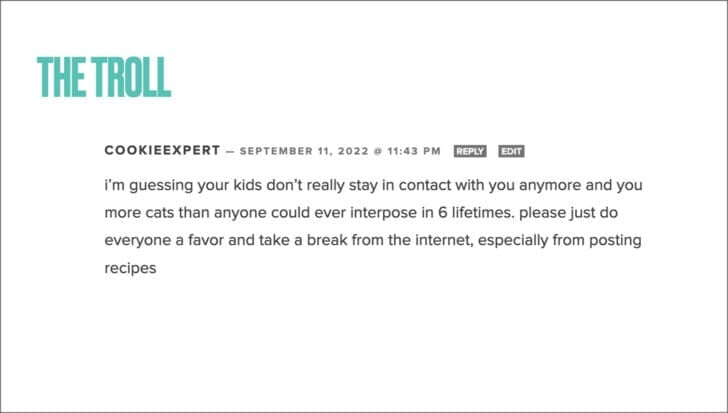
Don’t let the hateful comments bother you. I have developed a VERY thick skin, so you don’t need to feel badly for me. I read these kinds of comments out loud to my family at dinner time for a good laugh (and wise discussion on proper internet and good-human behavior).
Over the last 17 years, I’ve heard from thousands of people, mostly women, about dinner time. Menu planning. Feeding their families. Feeding themselves!
You name it, I’ve heard it.
So many of us feel the same way. While I LOVE food (as in, Brian will tell you to back away slowly if I start talking about food or recipes or dark chocolate or carbs), I don’t always love making dinner. Or meal planning.
Don’t think I’m up here being the proclaimer of: “IT’S AMAZING, ANGELS WILL BE SINGING! MAKING DINNER IS FUUUUUUUUN” No. Gosh, no. I’m in the trenches just like you are.
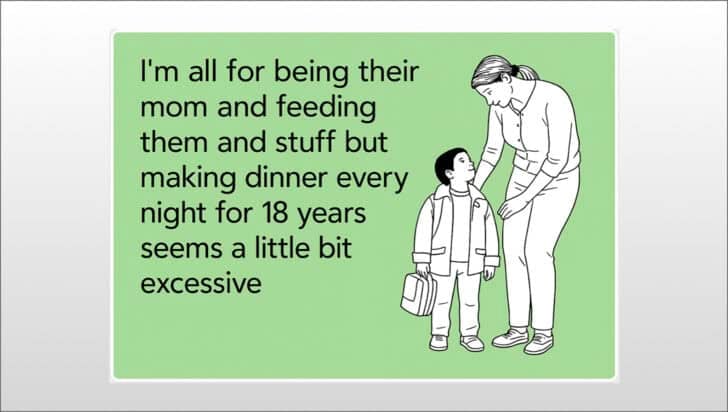
I recently polled my Instagram audience of close to 200,000 people to see what their biggest challenge and pain point was to getting dinner on the table.
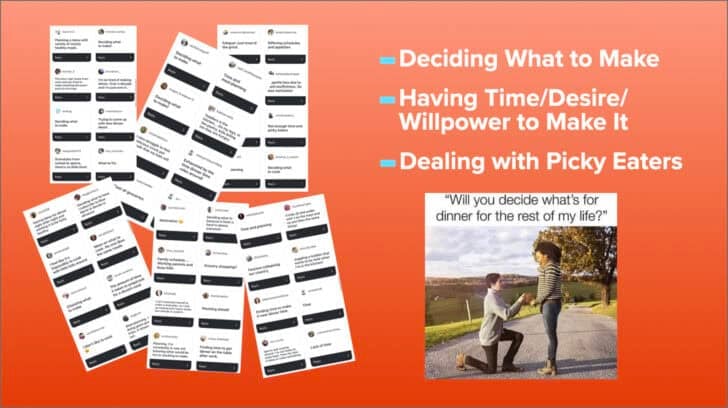
Thousands of people responded! Far and away, the three most common pain points mentioned (hundreds of times each) were:
- Deciding what to make
- Having the time to make it (and dealing with busy work/life/kid schedules)
- Working with picky eaters
AND the fact that they have to do it “over and over again every stupid night.” (That’s a literal quote from someone who responded.) 😜
Many people mentioned budgeting/money, but it was a distant fourth to these three topics.
So we’re going to dive in and address these pain points. I’m going to give you tips, resources, and strategies I’ve gleaned over the years.
These tips are universal. They can be adapted and used no matter your family structure or phase of life. Pick and choose the tips and strategies that resonate with you and you think could help you in your own circumstances.
➡️➡️ At the end of the day, I feel like as much of a pain as making dinner can be (night after night after endless night), it can also be a treasured time of family connection.
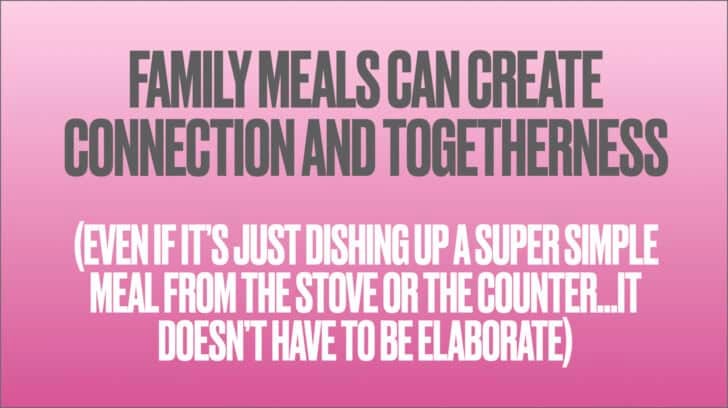
Recently, one of my adult sons who is living out of the country for two years commented that the thing he misses most about home is eating dinner with the family. Now, granted, what he probably meant was “someone making dinner for me” 🤣 but I thought that was profound when there are a lot of other things he could miss.
Dinner at our house is rarely fancy. We usually sit up at the counter on barstools and dish up family-style. It’s not always a real recipe (grilled cheese night, I’m looking at you), and we don’t do it every single night of the week with all the different schedules happening.
But trying for fairly consistent family dinners has been one of the best ways to have conversations (especially with teenagers) and spend time together, even if it’s just a quick 15 minutes each evening.
Ok, so let’s dig in and figure out how to make this happen!
At this point in the presentation, I like to hand out this printable to help follow along. I’ve included it as a free printable here, in case it is helpful. It is two pages (the second page is for note-taking).
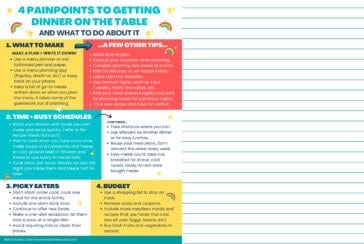
➡️ DOWNLOAD PDF HANDOUT HERE ⬅️

I know the thought of menu planning probably strikes dread into some of your hearts. It can be a drag, I get it.
But planning a menu is single-handedly THE BEST way to execute family (or single) meal times.
FIRST, I think we need to reframe what menu planning is. There are a lot of ways to approach menu planning and we’re going to talk about them.
Here are my top tips to take the dread out of menu or meal planning and how to RETHINK menu planning.
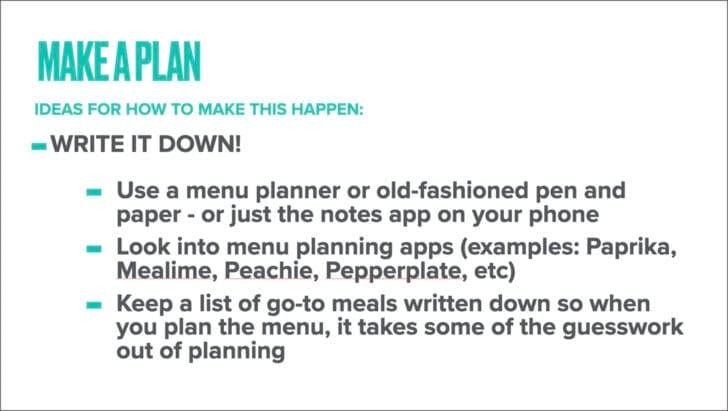
Make a plan and WRITE IT DOWN!
There are a lot of ways to do this, but here are three simple ideas:
- Write it out on good old-fashioned notebook paper, use a menu planning pad, or keep track on the notes app of your phone
- Use an app (Paprika, Peachie, Mealime, Pepperplate, just to name a few)
- Keep a list of go-to meals already written out so when you go to plan the menu, that takes *some* of the guesswork out of planning and makes some meals easy to fill in
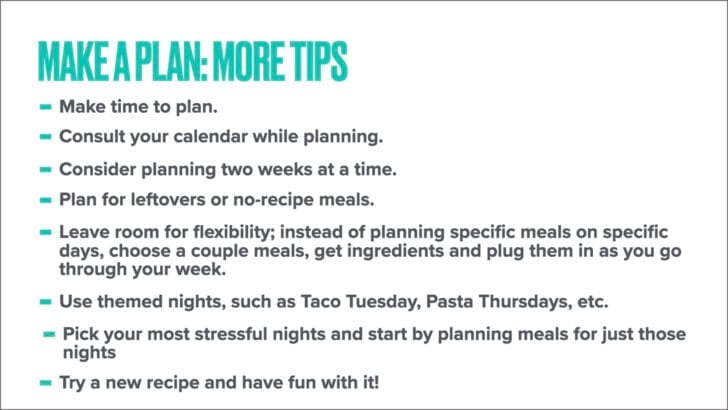
Make time to plan: You don’t need to spend hours planning your menu. Set aside 10 to 20 minutes, sit down and just do it.
Consult your calendar while planning: This means you will avoid planning a 5-course meal on a Tuesday night when you have three soccer games. 😜 The goal is to plan meals appropriate for the day/schedule.
Consider planning 2 weeks at a time: Confession…I dread menu planning, but if I know I only have to do it every two weeks, it doesn’t seem quite as bad.
Plan for leftovers or no-cook meals: You don’t need a brand, new meal every night! Check out the printable handout below with a whole list of no-recipe meals to plug in on nights that need a quick dinner solution.
➡️ Free Handout with a Whole List of No-Recipe Meals! ⬅️
Leave room for flexibility: One suggestion is instead of planning exact recipes/meals for exact days, instead have a more fluid approach. Choose, say, four recipes to make that week, get the ingredients for them, and as the week goes on, plug them into the days that work.
Pick themed nights: Taco Tuesday, Italian Thursday, Stir Fry-days, etc.
Pick your most stressful nights and start by planning meals for just those nights: Menu planning doesn’t mean you HAVE to plan all three meals for every day of the week.
Have fun with it! Maybe try a new recipe (if that’s fun for you)!

In the wise words of someone older than I am…

Listen, I’m no genie, but I can help with a few suggestions and tips to combat that feeling of “there’s no time (or desire!) to make dinner!”
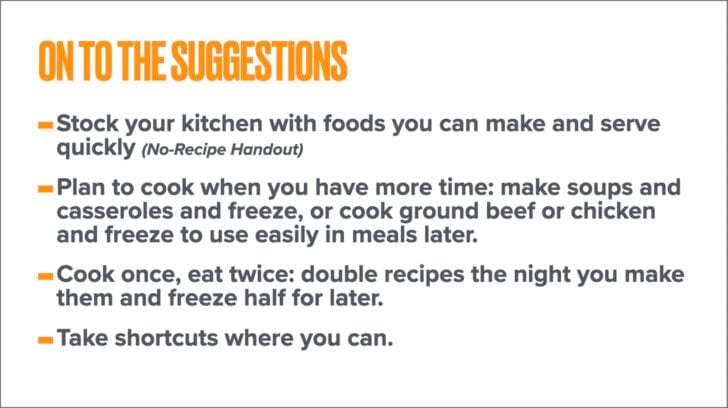
Stock your kitchen with foods you can make and serve quickly on busy days, like canned beans, tuna fish, quick-cooking oats, etc.
Cook when you have more time. If you have more time on the weekends or a particular day of the week, consider making recipes to freeze and reheat later. Or cook meat in bulk and store in the freezer to quickly pull out and use in things like chili, spaghetti, soups, etc.
Cook once, eat twice. If you can’t set aside several hours to put meals in your freezer, double what’s for dinner and freeze half for another day.
Take shortcuts where you can. Not everything has to be homemade. And you don’t need a home cooked meal every night, if your schedule doesn’t allow it.
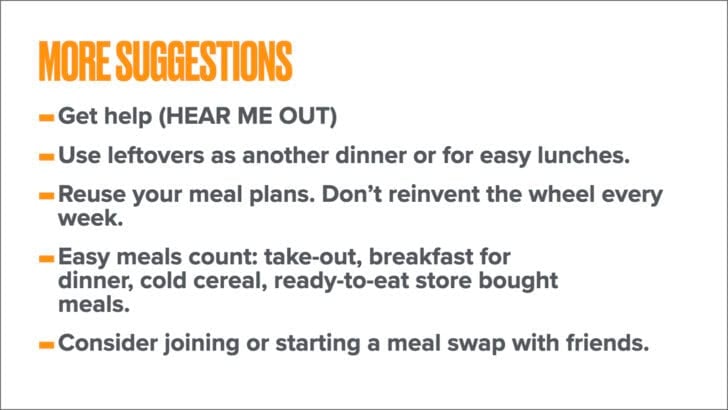
Now before you cringe, about “getting help” hear me out. I get it. Sometimes having help in the kitchen, whether it be a spouse or children, is more work than it is helpful! But here are a few tips to make it a bit more manageable.
- Divide and conquer: If you have a partner, divvy up the days (ie, someone takes M/W, someone else takes T/Th – and eat out on Fridays!). This has the benefit of spreading the work equitably and you always know who is responsible for which nights.
- Get kids involved to the extent your sanity can handle: Some families have success full-on delegating. I have a friend who is a full-time teacher with a large family. Each of her kids has a set dinner night where they plan and execute the meal for the family. Others do it differently. For us, we haven’t had great success assigning dinner nights. Instead, I utilize my kids’ help during the week for dishes/cleanup/small cooking tasks delegated in the moment, and I give them bigger assignments on Sundays to help with the Sunday meal (right now, because I have only two of my five kids living at home, they are rotating and each cooking dinner on alternating Sundays; they hate it, I love it.)
Use leftovers. Eat leftovers for another dinner or use leftovers for lunches.
Reuse your own meal plans. Keep your menu plans and recycle them or refer to them to get meal inspiration for a couple meals that week. Don’t feel like you have to reinvent the wheel every week.
Easy meals count. Take out, breakfast-for-dinner, cold cereal, ready-to-eat store bought meals – figure out what easy meals you can utilize to simplify getting dinner on the table.
➡️ Here are all my fast 20- or 30-minute recipes in one place. ⬅️
Consider joining or starting a meal swap with friends. I have heard from a lot of people over the years who have had great success in meal swap groups (either for lunches or family dinners). The idea is if there are five people in the group, each person would make five batches of whatever meal they are making (lasagna, enchiladas, whatever) and deliver it to each person in the group. You cook once but have meals for five days of the week.

There’s no one kitchen tool that’s going to save dinnertime, but these are a few things I use over and over and over again that help simplify dinner-making.
- Instant Pot (all my favorite Instant Pot recipes here)
- Slow Cooker (my go-to slow cooker recipes here)
- Stove-to-Oven pan (this is brilliant for meals that need both the stovetop and oven – only one pan to clean! I use it all the time)
- Griddle (we use this almost daily – everything from pancakes to crispy wraps to grilled cheese)
- Handy Chopper (this makes chopping so quick and easy)
- Fave Knife (I have three of these inexpensive knives in my drawer, because we use them so often)

And by picky eaters, we aren’t always talking about the kids, amiright? #husbands 👀
It’s likely not all of these tips will resonate with everyone. There are a lot of strong opinions that often follow generational lines when it comes to feeding families/children. Additionally, some individuals have sensory challenges that make eating/picky eating an entirely different experience.
However, hopefully some of these tips will help if you’re navigating cooking meals for picky eaters.
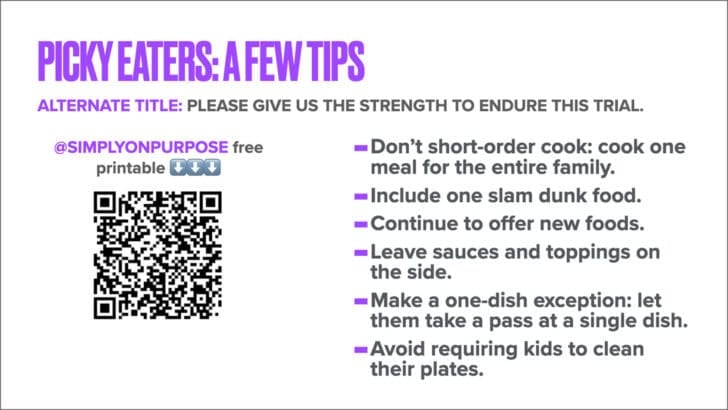
Ralphie @simplyonpurpose has a free “eat the rainbow” guide that I’ve heard is really awesome. This link will take you to Instagram with details.
A few additional tips:
- Don’t short order cook. Cook one meal for the entire family (see the second tip below – it goes along with this one!).
- Include one slam dunk food. Try to have meals where there is at least one thing that your selective eaters will like (it can be simple: crackers or bread with soup, fresh fruit as a side dish, sliced cheese, etc). Doing so means you can make one meal (tip #1) and know that even if they don’t like what’s being served, there is something they will eat.
- Continue to offer new foods. It can be easy to want to give up serving or encouraging your family to try new things, but keep in mind that it can take up to 11 times for a child (or teen) to decide they like a new food.
- Leave sauces and other toppings on the side. This is especially helpful for those kids that don’t like their food to touch or be mixed.
- Make a one-dish exception. Let them have the choice to take a pass at one single dish without it becoming a power struggle.
- Avoid requiring kids to finish everything or clean their plates. Sometimes one bite (or even dabbing at the food with their finger) is good enough success, especially if the goal is to build healthy relationships around food.

I am living proof that this bonus tip works.

I’ll just touch on this one briefly.
Everyone has different circumstances and your idea of budgeting may be totally different than someone else’s but here are a few universal tips that can help in any scenario.
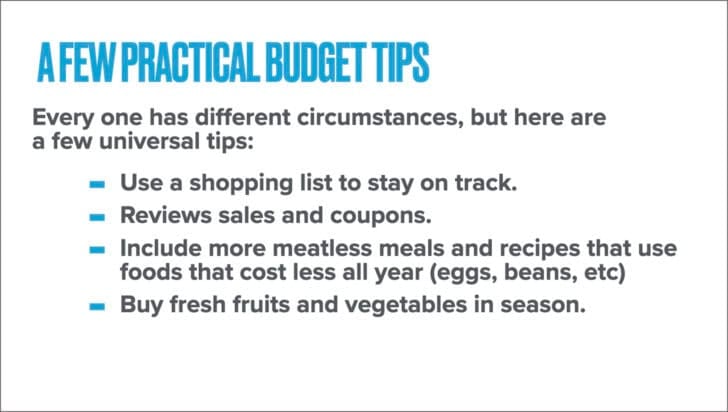
A few practical food budgeting tips:
- Use a shopping list to stay on track.
- Review sales and coupons to stay on track.
- Include more meatless meals. ➡️ My favorite meatless main dish recipes here. ⬅️
- Eat foods that cost less all year long (like, beans and sometimes eggs).
- Store fresh foods in the fridge right away to help them last longer and keep them from spoiling.
- Buy fresh fruits and vegetables in season.
And that’s a wrap!
I know this has been a ton of information and rather long, but hopefully it has been helpful in some way.
As a recap, here are the printables I included up above in the post for easy reference.
➡️ Colorful PDF HANDOUT that follows the presentation ⬅️
I have a very picky hubby who likes maybe a dozen foods. I’m a self-proclaimed foodie so this is a very large pain point, as you can imagine. We don’t have kids at home so I’ve simplified meals around here – I’m mainly talking dinners – by making a list of what hubby will eat. Grilled cheese counts as simplified! I will then resist the urge to repeat dinners over a month’s time by keeping a record on my google calendar of what we had when. You read that right! We’ve been married going on 7 years and just this week, I learned that hubs only likes rice with teriyaki sauce. Having said that, I (and you!) made his day when I made two batches of your caramel pecan (sans the pecans for mr. picky) sticky buns. Thank you, Mel!
I love all of these ideas! Such a good class to teach. Do you still use prepear app? I’ve used it for years and loved it, but recently it won’t work for me to populate my grocery list. I loved how it linked to Walmart grocery and I could just shop right from there from the list prepear made, but that isn’t working for me anymore either.
Finally got around to reading this blog post. It has some helpful tips and info for me. And I feel more validated with the work it takes to get dinner on the table. I love to cook but some days it’s like really? Dinner again? Thank you Mel! And I am glad you laugh at the rude comment posts 😄. I am sure it makes it funnier reading them out loud to your family. Thank you for being a kind, positive, and bright spot on the internet. I have loved making and eating your recipes. It has been almost 11 years since I first heard about you. How time has flown and I know you have know idea who I am, but I still consider you a friend. Food Friends Forever. Haha! God bless.
Woops typo. *No idea* not know idea 😅
Oh WOW!! This is AWESOME! Thank you sooo much for putting this together, all in one place. Over the years I’ve heard you mention most of these tips on your blog, and I’ve internalized most of them. But it’s great to have it spelled out here, with beautiful fliers, to boot. Nice!! And very timely, as I’m presenting to a church group next week all about Meal Prep and Planning tips. It’s like you READ MY MIND! Many many thanks friend! (I call you “my friend Mel” all the time when my kids ask where I got another great recipe.)
By the way, we eat “Mel’s Kitchen Cafe” on the regular and we’ve not come across a meal my pick eaters won’t try. Thank you for your years and years of meal sharing and tips! Yours is a known name in our house!