

Easy Ultra-Fluffy Focaccia Bread {No Knead, One Bowl}
This is the easiest focaccia bread recipe ever! And the results are amazing: bubbly, ultra-fluffy crumb and golden, salty crust. It is incredible!
We can’t get enough of this bread! It is quite possibly some of the most amazing bread to ever come out of my kitchen, and it is SO EASY to make. It is perfect for a side dish, dipping in oil and herbs, and it makes incredible sandwiches.

Why This is The Best Focaccia Bread Ever
I can’t even tell you how many times I’ve made this bread. It has become my go-to bread for pretty much every occasion!
Here’s why it is the best focaccia bread recipe:
- The dough is mixed by hand in one bowl with a spatula. So easy! No kneading and no stand mixer needed.
- The dough can be baked same-day (many recipes call for resting the dough overnight, which isn’t necessary to achieve focaccia perfection with this recipe).
- The bread is ultra-fluffy with the most delicious, golden, salty crust and the signature bubbles that define focaccia bread.
- It is perfect as a side dish for just about any meal, and it also makes the most delicious sandwiches (cold sandwiches or pressed/panini sandwiches!).

Ingredients Overview
Don’t blink or you’ll miss it! This ingredients lineup is short and sweet, but the details are important, so read through the notes.
- Bread flour: This focaccia bread turns out fluffier and better with bread flour. In a pinch, you can sub in all-purpose flour, but bread flour produces a superior end result.
- Instant yeast: I keep my yeast in a quart-size jar in the freezer and measure out, as needed, for recipes. If you are using packets of yeast, one packet (about 2 1/4 teaspoons) will work fine for this recipe. No need to open up a second packet for the additional 1/4 teaspoon yeast. Instant yeast is sometimes labeled as “rapid-rise” yeast.
- Salt: Use table salt in the dough.
- Water: If you have a kitchen scale, I recommend weighing the water (and flour, too). Use very warm water, about 105 to 100 degrees F.
- Olive oil: I use extra-virgin olive oil.
- Flaky sea salt: This ingredient adds delicious flavor and a little crunch to the top of the bread. I prefer using flaky sea salt (like Maldon). If you don’t have sea salt flakes, coarse salt can be used instead.


How to Make Focaccia Bread
While this focaccia bread recipe is exceptionally easy, there are a few important steps to follow to make sure the bread turns out perfectly.
- Mix the dough ingredients together in a bowl until the dough looks shaggy and no dry spots remain.
- Let the dough rest.
- Stretch and fold the dough 12 to 15 times (more on why this is important below ⬇️).
- Let the dough rest.
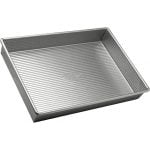
- Line a 9X13-inch pan (preferably light-colored metal pan) with parchment paper and drizzle with olive oil.
- Gently lift the dough out of the bowl and into the pan.
- Cover and let rise until the dough has filled 90% of the pan and is very puffy.
- Drizzle the top of the dough with olive oil.
- Use your fingers and slowly press into the dough all the way to the bottom of the pan. Doing this slowly and gently gives the focaccia the signature dimples without deflating the dough. Repeat this process all across the dough.
- Sprinkle with flaky sea salt and bake until golden.
Parchment paper hack: Baking this bread in a parchment-lined baking pan ensures the bread won’t stick to the pan AND it makes it super easy to remove after baking. To get the parchment paper in the corners of the pan, take a piece of parchment paper about 12X16-inches and crumple it into a ball. Unfold it and lightly smooth it out. It will press into the corners of the pan much easier now!


Why the Stretching and Folding is Important
Focaccia dough relies on high hydration to achieve the classic fluffy/airy crumb. For my recipe, the hydration is right about 86%.
Because of that, when first mixed, the dough is going to look rough and shaggy. The stretching and folding is important to help develop structure in the soft, wet dough and also form the bubbly interior of the bread.
You can see from the pictures below how the dough evolves from a wet and shaggy mass to a more cohesive ball of dough after the stretches and folds (and after resting in the bowl).
➡️ I tested this recipe multiple times with and without the stretching and folding, and I can confirm that the focaccia bread turns out far better following the recipe through all of those steps.


A Few Last Notes
I can’t wait for you to make this recipe! It really is the easiest and yummiest focaccia bread I have ever made. It has become an absolute staple in my kitchen – I’ve been making it nonstop!
If you are interested in using sourdough discard in this recipe, it should work quite well with a bit of experimentation. As a starting place, decrease the flour and water in equal amounts based on how much sourdough discard you add (for instance, for 1 cup sourdough discard, decrease the flour by 1/2 cup and the water by 1/2 cup).
Serve this wonderful focaccia bread with everything from saucy pasta to simple sheet pan dinners. It’s also crazy good dipped in olive oil and herbs. But the way we enjoy it most is tearing off big hunks and eating it straight out of the pan.
The golden, crackly crust and super fluffy interior is the stuff dreams are made of.


Easy Ultra-Fluffy Focaccia Bread
Ingredients
- 3 ½ cups (497 g) bread flour (see note)
- 2 ½ teaspoons instant yeast (see note)
- 2 teaspoons table salt
- 1 ¾ cups plus 2 tablespoons (427 g) very warm water, 105 to 110 degrees F (see note)
- 6 tablespoons olive oil, divided
- Flaky sea salt, for sprinkling on top of dough
Instructions
- In a large bowl, add the flour, yeast and salt. Mix to combine.
- Add the water and 2 tablespoons olive oil (24 g). Mix until the dough is shaggy and no dry streaks remain, scraping down the sides of the bowl well. Cover the bowl and let the dough rest for 30 minutes.
- Rub hands lightly with olive oil or run under cool water (so the dough doesn't stick). Grab one edge of the dough and lift and stretch it up and over to the other side. Turn the bowl slightly, and grab another edge, lifting and stretching up and over to the other side. Continue this process, moving around the edge of the dough, until you have stretched and folded the dough 12 to 15 times. This process helps develop structure and form the bubbly interior of the bread.
- Re-oil hands if needed and gently turn the bread over so the seams from stretching and folding are on the bottom. It's ok if it doesn't look perfect, just cup your hands and tuck the dough in towards the bottom forming as round of a shape as possible.
- Cover the bowl and let the dough rest for 20 to 30 minutes. This helps relax the gluten in the dough – you can skip this step, if needed.
- Take a sheet of parchment paper about 12X16-inches and crumple into a ball. Unfold and smooth out the parchment and then press it into the corners and up the sides of a light-colored metal or glass 9X13-inch baking pan.
- Drizzle 2 tablespoons of olive oil over the bottom of the parchment paper.
- With oiled hands, gently lift the dough out of the bowl and place in the center of the prepared pan, gently and very lightly stretching it into a thick oval shape (it won't cover the entire bottom of the pan at this point).
- Cover the pan and let the dough rise until it has filled most of the pan and is super puffy, 1 to 1 1/2 hours.
- Preheat the oven to 475 degrees F for a light-colored metal pan and 450 degrees F for a glass pan. Place an oven rack in the center position.
- When the oven has fully preheated, drizzle the top of the dough with 1 to 2 tablespoons olive oil.
- Use your fingers and slowly press into the top of the dough all the way to the bottom of the pan. Lift your fingers up and out of the dough gently (if the dough is sticking to your fingers, drizzle a bit more olive oil across the dough). Dimpling the dough slowly and gently gives the focaccia the signature dimples without deflating the dough. Repeat this process all across the dough.
- Sprinkle the top of the dough with flaky sea salt.
- Bake for 16 to 17 minutes (for a metal pan at 475 degrees F) and 18 to 20 minutes (for a glass pan at 450 degrees F) until the bread is golden and baked through.
- Lift the bread out of the pan using the parchment corners and place on a wire rack to cool completely.
- Cut into squares and serve. This bread is fantastic as a side dish and it also makes excellent sandwiches (slicing the bread in half lengthwise).

This is so good! I had great success with using 100grams of starter (taking away 50g each flour and water). It was so fluffy and soft and absolutely delicious!
Thanks for sharing that about the starter!
Oh my gosh! I’ve never attempted focaccia bread before, but this was so easy and slapped! At this point, I’m hoping it makes it to dinner time, but we can’t stop eating it! Thank you for sharing!!!
Yay, Lara!! So happy your first time making focaccia was such a success!
Best bread ever!
Thanks, Erin!
Can I use reg yeast for this?
Hi Nanci – are you referring to active dry yeast?
Yes
If you dissolve the same amount of active dry yeast in a few tablespoons water until it bubbles and then add it to the recipe, that should work.
I’ve made this at least once a week this entire summer. It is the most requested food item for summer 2026. And I make a double batch every time. It doesn’t last long….
This put a big smile on my face, Amy! You are a rock star to make this weekly (hope your family knows how lucky they are!).
This recipe is fantastic. I have made other focaccia bread recipes that take much longer, but this one is simple, fast, and great flavor. My family loves to use this focaccia bread for sandwiches–like Italian grinders, BLTs, and breakfast sandwiches. Thanks, Mel!
Thanks for letting me know, Julia! So, so happy you love this recipe (it really is so great for sandwiches – that’s how we love it, too!).
I made it today and it came out wonderful and delicious! I added chopped rosemary and sprinkled with gray salt. It was a hit!
Can’t wait to try it with fresh rosemary!!
This bread was AMAZING! I followed everything and it was as easy as Mel said it would be. I used as sandwich bread for an Italian grinder sandwich and results were DELICIOUS! Will be making this again!
So happy to hear that!
This was my first time ever making focaccia (and really, bread without a bread maker) and I added rosemary to the top and it is SO GOOD. (Next time will add some in the dough too.) So excited to be able to have this new recipe up my sleeve; I foresee it being made many many times. Would definitely LOVE a cinnamon bread version!
Yay, Stephanie! So happy you loved this! And I’m working on a cinnamon version – stay tuned!
If I double this, what size pan should I use? Is a rimmed large baking sheet ok or will that be too small?
Hi Emily, I think you could definitely use a half sheet pan (11X17-inch rimmed baking sheet). The sides of those pans aren’t as high as a 9X13-inch pan so the bread may not be quite as tall, but I still think it should work out quite well.
The flavor of this bread is outstanding! So easy and SO GOOD. Will be making it all the time!
Thanks for taking the time to let me know you loved this one, Nicole!
So delicious and easy! My whole family loved it
So happy to hear that!
My new favourite focaccia recipe! So easy. Love that it’s a same-day recipe.
Fantastic flavour, and it reheats like a dream. I sliced the leftovers into thin strips and dipped them into Mel’s homemade tomato soup recipe. All the 5-star reviews are correct – this is a wonderful recipe. Thanks Mel!
Oh yum, sounds amazing serving this bread with the tomato soup. Thanks, Darlene!
So delicious and soft and easy! I sprinkled the top of mine with everything seasoning and some canned parm (like I do for breadsticks) and then sliced the whole loaf in half and turned it into a giant Italian grinder ala Sara at Our Best Bites. Holy smokes! What a sandwich! Can’t wait to make this again … and again and again!
That sounds so incredible, Kimma!! Thanks for sharing!
Absolutely delicious and easy! My family devoured it. Can’t wait to make it again and try some add ins.
Thanks for letting me know you loved this bread, Jenni! I can’t stop making it!
Why no sugar?
Traditional focaccia bread recipes don’t include sugar (and it really isn’t needed in the recipe).
This was so good! Fluffy, easy, and so addicting!
So happy you liked it – thanks for letting me know, Tanya!
My husband: This is the best bread you’ve ever made.
It was so incredibly easy that my 8 year old did most of the work and felt incredibly proud of herself, which is a win itself. We had to stop ourselves from devouring the entire loaf. I chopped up some fresh rosemary for half of it and highly recommend!
10/10 – an absolute keeper recipe!
Oh yum, Maria – can’t wait to make it with fresh rosemary like you suggested! So thrilled you and your family loved it! Way to go!
This bread is SO delicious and SO easy! I couldn’t ask for anything more from bread. Just typing this makes me want to make it again. It’s so yummy!
That put a huge smile on my face, Jennifer! Thanks for taking the time to let me know!
Do you think I could put the dough in the fridge before the longer rise to get it to work with my church schedule/family dinner schedule on Mother’s Day? I’m excited to try it!
Sorry for the delay in responding – but yes, you can absolutely do that!
Mel! I would love one of ur amazing thouragh tutorials on doing this with sour dough!
I’m working on a 100% sourdough version and will get it posted as soon as it is just right!
Maurizio at The Perfect Loaf has a sourdough focaccia that is to die for.
Has anyone made this with half whole wheat?
I have fine sea salt. I don’t keep table salt in the house. Will the fine one be OK for the dough instead of table salt?
Yes, that will be fine in the dough.
So good, Mel! This was such an easy recipe to follow and it yielded fab results. Thick bread with that satisfying crunch from the olive oil. We will definitely be making this again and again! (Thank you for always including the metrics on your recipes. It is SO helpful.)
Are we going to be seeing variations of this recipe like we did on the croissant French bread? Maybe a cinnamon roll focaccia? 😉
Thanks for the comment, Megan! So happy you loved this. And you know me too well, haha. Yes, I have a few variations already up my sleeve. 🙂
This looks amazing!! Do you think I could add garlic seasoning to make it a little garlic bread?
Absolutely!
Made this immediately for my family – it was to die for! I kept just saying, “This is so good!” over and over again. Thank you!!! Will be a new staple for family and company!
This made me so happy, Brittany! I just made a double batch today and kept thinking “I hope someone else made this and can’t stop eating this like me today” haha Thanks for letting me know!
Can I use my mixer dough hook?
Hi Marie, I’m sure you could use your dough hook, however, this dough is so easy to mix by hand, it really isn’t necessary.
Can I use my bread machine? Please expand on directions if I can
Hi Theresa, I don’t own a bread machine and so I’m not a lot of help answering this question and don’t want to steer you wrong. A quick google search tells me that yes, you can use the bread machine to mix the dough, but to achieve proper texture and golden crust, you’d need to bake the dough in the oven.
This looks so good and seems very manageable! Thank you for the detailed instructions. I’m curious if you have any recommendations for variations. Did you experiment with adding herbs and/or cheese in the dough or on top?
Hi Brett! Good question! I haven’t added any add-in ingredients to this recipe, but I have with other focaccia-bread-type recipes and it works great! You can add finer/smaller ingredients like herbs during the initial mixing and maybe add thicker/chunkier ingredients during the stretching and folding. If adding ingredients to the top of the bread, I would do so after dimpling the dough.