

Kitchen Tip: Measuring Flour
How do you measure flour? Dip and sweep? Dip and shake? Check out this kitchen tip on measuring flour to learn why it makes a difference.
How do you measure flour? Do you dip and sweep? Dip and shake? How about spoon and sweep? You may not think it matters how you measure flour, but let me assure you it does.
Far and away, the best method for success to get those cookies to spread perfectly, bread to be soft instead of stiff, cakes to be moist instead of dry, is to weigh your flour (and other ingredients). To do this, you need to either possess weird superhuman powers or possess a kitchen scale. I have a simple kitchen scale (a Salter version that isn’t sold anymore) that I’ve been using for years and it does the job quite well.
You don’t need to pay out a lot of money to get a great, functional kitchen scale.
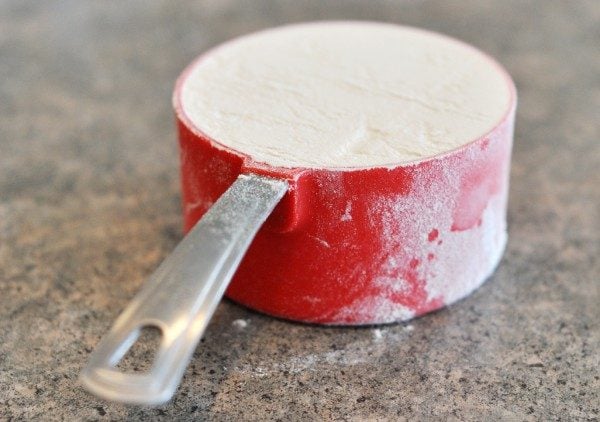
Scales are fantastic if a) you have one and b) the recipe you are using gives you a weight measure along with a cup measure.
However, if you don’t own a kitchen scale and your recipe doesn’t give a weight measure, then the next best thing is to make sure you are measuring flour correctly. That’s why I’m here! I took it upon myself to conduct a little experiment in my kitchen today. I became half scientist just for you.
Follow me.
I weighed a cup of flour using three different techniques:
Dip and Shake
Gently scoop the cup into the flour.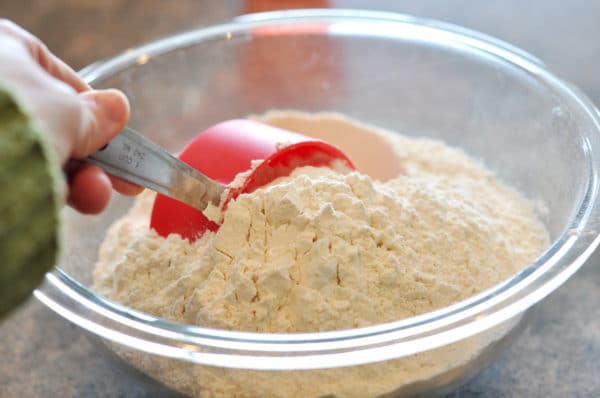
Scoop it deep so the flour is piled high.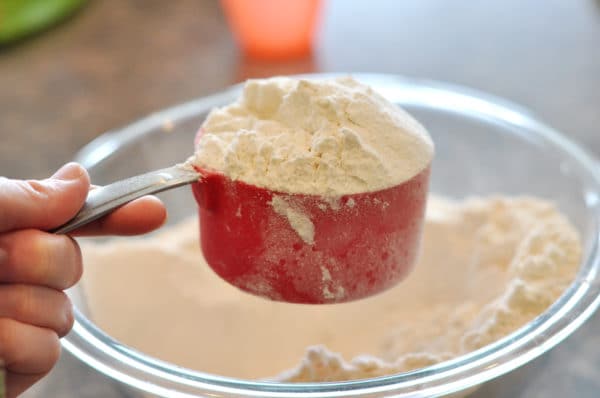
Then shake the cup until it is level.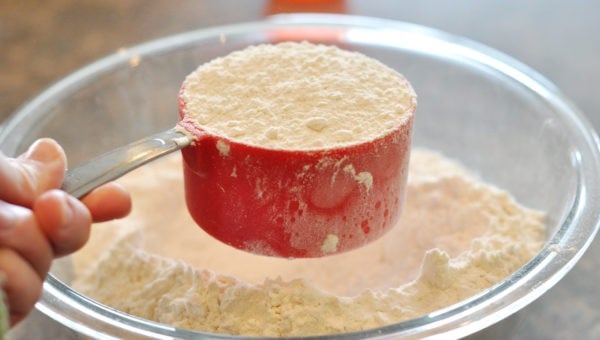
Dip and Sweep
Again, dip the cup into the flour so that it piles high. Don’t slam it into the flour and overpack – just gently scoop the cup through the flour to fill the cup.
And then level it off with a flat edge.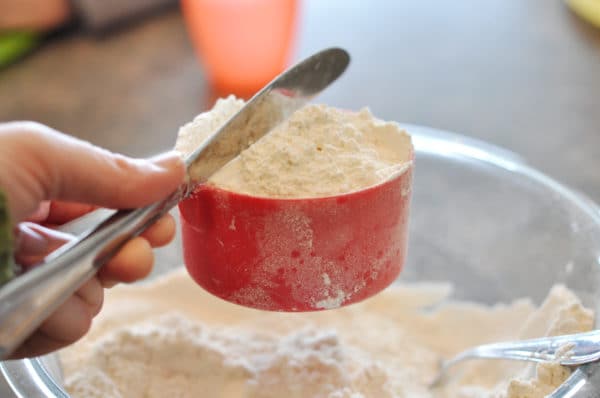
Spoon and Sweep
Spoon the flour into the cup until it is just slightly over the top of the cup.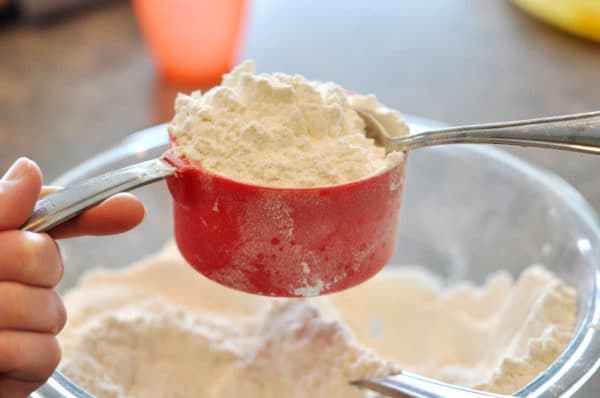
Level the flour off.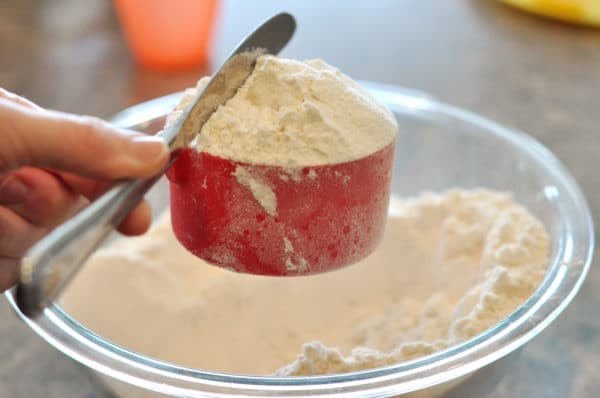
Here are the results:
The Dip and Shake method produced a cup of flour that weighed 6 ounces.
The Dip and Sweep method produced a cup of flour that weighed 5 1/4 ounces.
The Spoon and Sweep method produced a cup of flour that weighed about 4 ounces.
To make the results mean something, here’s the following piece of information – most recipes I’ve seen written with weight measures have a cup of all-purpose flour weighing in at right around 5 ounces, give or take a little (cake flour, bread flour, and whole wheat flour vary in weight but since I used all-purpose flour for my highly scientific experiment today, we’ll dwell on it for now). You can see from the above results that the dip and sweep method came the closest to the 5 ounces a cup of all-purpose flour should weigh.
An ounce or two difference in flour is a huge, and I mean huge, variable in the outcome of baked goods. Cookies with even slightly too much flour won’t flatten but with too little flour, they’ll spread into a pancake. Bread with a tad too much flour can be dry or have issues rising. Cakes with too little flour can sink or flatten and too much flour? Dry again.
So what’s a home chef to do with this information?
Here are my recommendations:
1) If at all possible, invest in a kitchen scale. If a recipe gives you a weight measure. Use it. You’ll get the best results using a kitchen scale whenever possible.
2) For all the recipes that do not have weight measures listed (or if you do not have a kitchen scale), use the Dip and Sweep method (this same method is also recommended by Cook’s Illustrated – I’m so glad they agree with me). It should comfort your flour-measuring soul to know that I always use the dip and sweep method when a recipe doesn’t give a weight – so all of the baked good recipes posted here without a weight measure have been tested, baked and deemed worthy using this flour measuring method. You’ll get the best results on my baked good recipes by dipping and sweeping (and of course, weighing when you can).
As a sidenote: when it comes to yeast doughs, I never use the flour measurement as a hard, fast rule. Instead I go by the feel and look of the dough (you can read more about working with yeast here).
Added Disclaimer: Ok, after the email and comment onslaught, I just have to state this for posterity’s sake – if you use a flour measuring method other than the one I recommended and your baked goods always turn out perfectly, well then, don’t feel pressure to change! This is my recommendation only and I know there are many of you out there who are better bakers than I that may employ the dip-twirl-shake-spoon-level–hula flouring method and it works great every time. Just sayin’ – do what gets you the best results but keep in mind that my very, extremely, highly scientific research (and other creditable sources) point to the dip-and-sweep as a preferred method. Over and out.
I don’t understand how this recipe can be correct—there is NO WAY I could get the ingredients, as shown, to form a ball—and yes I stirred and stirred and stirred. And stirred. I finally resorted to doubling the oil and milk but that barely made a difference. Finally, I reluctantly added an egg (probably more egg than needed) which bound the ingredients. They actually taste pretty good in spite of the changes although I’m writing to you before they have had time to harden. I would LOVE to give your recipe MANY stars, especially because of NO butter, so little oil and sugar, and quick prep but you have to do something about the mixing challenge.
Hi Michael – what recipe are you referring to?
I think it should also be pointed out that even when cookbooks do not state the wieght, the weights are sometimes found in the beginning pages of the cookbook, so always check that for the method used in that particular book. To further confuse things, King Arthur Flour, a well respected company, weighs in a cup at 4.25 ounces, which is the weight for flour “lightly spooned in and leveled”. The baking book author Carole Walter also uses this method. If you bake from many sources, I think you have to adjust the method of measuring to that source.
Hi! I found this site while searching for reasons to explain a major cookie mishap! My teens decided to make cookies alone for the first time while I was asleep and they nearly set my kitchen on fire!! They melted all over the racks and oven and they didn’t notice until smoke started . My guess is they forgot the flour? Is there anything else you think it could have been? They said the batter tasted fine lol. One other note-they were using the toll house recipe and cutting it in half.
Thanks !! Karen
Found this site when looking for butter recommendations. Love your site! I’ve never had a cookie come out the same before. Wanted to make cookies before family gets up. Can’t wait to try!
I noticed that you dipped from flour in a bowl, so this content isn’t a criticism of your technique, but is meant as clarification to some of the novice bakers out there.
ALWAYS stir or otherwise “fluff” the flour in your canister before dipping. If your flour has settled in the canister, it will pack the cup when you dip into it.
Also, to underline your point, reliable kitchen gram scales can be had online for very little money ($10 – $15), SO BUY ONE!
All modern online chefs SHOULD always post recipes in grams (or at least ounces), but many do not. Worse yet, many use 140 gms/cup as their standard (dip & sweep), and many (King Arthur’s) use 120 gms. If you’re working with a volumetric recipe, and converting it to weight, unless you KNOW the recipe author uses spoon & sweep, use the more common 140 gm method first, and decide by the results if you should adjust the recipe the next time. Yet another reason to never try a new recipe out for a special event. Experiment first on you family & loved ones…
Hi Mel, this is awesome! I came back to find this post as I noticed a cookie recipe once where the flour was weighed at 12 oz (3cups of flour), then the recipe was later changed to 2 3/4 cups but still listed for 12oz of flour? I thought weighing would make it foolproof. So how could it still be listed at 12 oz? So confusing!
I plan to make your CCC and I see the flour is weighed so just want to get this right! Thanks so much!
I recommend you to use Food scale to measure the flour as it will be more accurate and you will be able to work more precisely.
So, Mel….I would then use 5 1/4 oz of flour for your recipes that call for a cup of flour if you don’t give a weight? Is this correct? BTW, love the cake and the site!
Hi Irene – if I haven’t given a weight in the recipe, it means I haven’t tested or remade the recipe using weight. So I can’t say that every recipe will convert straight across from cups to weights but in general, because I measure my flour consistently the same way, 5 – 5.25 ounces of flour per cup is a good guideline. 🙂
My 2 shiny copper coins…. i love that you take the time to work through all these different issues and then spend even more time sharing. I choose weight every time and scratch notes on recipes so i can duplicate or adjust with confidence. Mel u r awsome!
Thanks, Bear!
I came across your site as I was trying to find info on how to perfect a cookie dough recipe I’ve been working on. I read both the posts on butter temperature, and dough temperature (good stuff, by the way) which led me here. Obviously, the more accurate you can be when measuring ingredients, the better your results, so I tend to agree with you on weighing the flour. However, if you are going to take the time and effort to weigh the flour to get a precise measurement, why would you not then do the same for the rest of the ingredients? I know this is a very old post and I read through most of the comments before deciding to put my 2 cents in, but as far as I saw no one else mentioned doing this either. If you are going to weigh the flour, you should then “scale” the remainder of the ingredients in your recipe according to the amount of flour. This will make sure you always have the correct ratio of ingredients and more importantly allow you to duplicate the results each and every time. There is math involved (I know, I know) but, if the end result is a delicious cookie EACH AND EVERY TIME…a little math is worth it.
Hi Mel,
Thanks very much. When a try one of your recipes, I will use 142 grams for every cup of flour.
Thanks Mel and Christy for your answers.
I know the weight depends on the type of flour you use. I use mostly all purpose flour.
Mel – I wan’t to try some of your recipes and that’s why I asked how much a cup of all purpose flour you use weights. If you bake for instance your blueberry muffins you use 2,5 cups of flour. How much is the 2,5 cups of flour you use in grams. I know the gram value depends on how the flour is packed into the measuring cup, but if YOU bake them, how much flour do you have in your measuring cup?
Sorry for all the questions. It would be so much easier if we all used the same measuring method all over the world.
Hi Elys – I agree, it can get really confusing with all these different methods of weighing flour! I only weight my ingredients if the recipe specifically states a weight measurement. My understanding is that a cup of flour usually weighs more than 4 ounces. Cake flour is the exception – a cup of cake flour usually weighs 4 ounces but Cook’s Illustrated (they run an in-depth test kitchen) uses 5 ounces for 1 cup of flour. You can see how not only does the weight of flour differ by brand but also by recipe. Basically, there is no real standard. In my baking when I’m creating a recipe and weighing ingredients, using the dip and sweet method, my cup of flour weighs in right around 5 ounces so that is the amount I use; however, when using the recipes posted on my blog, not all of them have been tested converting the cups to weights. If you are looking for a place to start, I’d recommend using 4.5 to 5 ounces (5 ounces is about 142 grams). Good luck!